
What Is the Right Form Factor for Emergency Epinephrine?
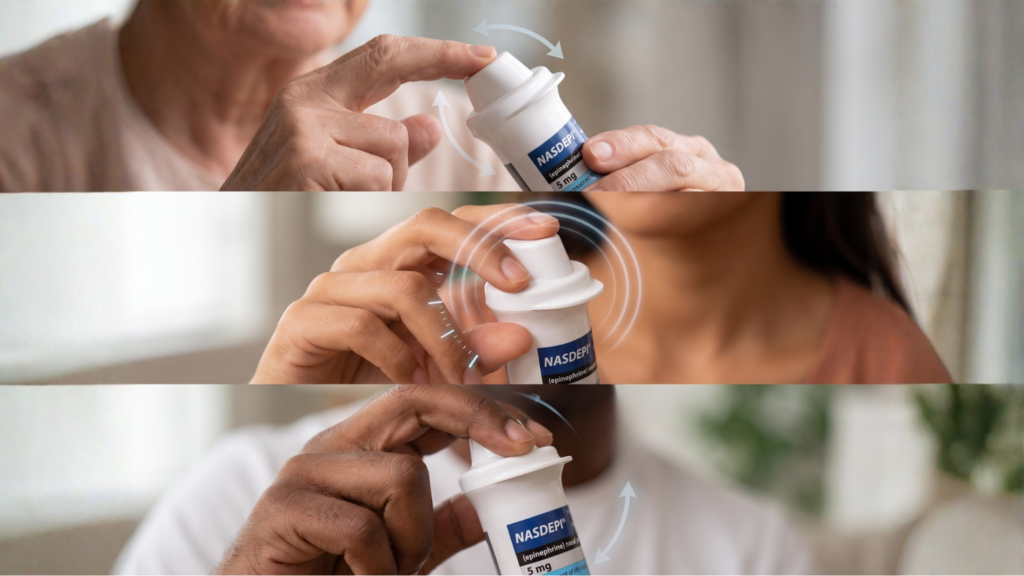
Beyond Form Factor, Why Human Factors Matter
In an anaphylactic emergency due to a severe allergic reaction, effective treatment is only beneficial if it can be administered correctly and promptly.
This raises a key question: What makes an emergency epinephrine device truly easy and safe to use when seconds count?
Anaphylaxis can occur quickly and unexpectedly, and the individual administering the emergency epinephrine could be the patient, a parent, a caregiver, a nurse, a teacher, an emergency responder, or a bystander. They may have never used the device before or may have received training months or even years prior. Additionally, they may be trying to make quick decisions amid noise, distractions, and the stress of a life-threatening situation.
Designing an effective emergency-use epinephrine device goes beyond size, shape, or step count. It raises a fundamental question: Can people who need to use the device use it correctly under stress and recognize when they’ve completed the dose?
Addressing these questions through Human Factors studies has shaped the design and development of Nasdepi®, our investigational dry powder nasal epinephrine product.
What You’ll Learn In This Article:
In this article, we’ll explore how consideration of the following concepts can impact the usability of an emergency epinephrine device when it matters.
- What Does “Intuitive” Mean for an Emergency Epinephrine Device?
- Why “Trained” Doesn’t Mean Error-Proof
- Rethinking Simplicity: From Step Count to Critical-Task Analysis
- Testing Emergency Epinephrine for the Real World
- What the Right Form Factor Means for Nasdepi®

What Does “Intuitive” Mean For an Emergency Epinephrine Device?
Human Factors studies evaluate how intended users interact with a product in the environments where they are likely to use it. The findings can help identify design improvements that support safe and effective medication delivery.
Emergency-use products have to account for two critical realities:
- Users may have little or no prior experience with the device. The user experience therefore extends beyond the device itself and is influenced critically by the user interface, encompassing the device, its packaging, labeling, artwork, and instructions for use. Each element can significantly impact the user’s understanding of what to do and how to do it.
- It cannot be assumed that users will have the time to study lengthy instructions in a critical moment.
An effective user interface should guide users towards the intended action(s). In the context of Human Factors, “intuitive” design means more than a device appearing simple or requiring only a few steps; it means that users can identify, understand, and perform critical handling and dosing steps correctly. It means that, more likely than not, a target user would be able to use the device correctly when faced with a life-threatening situation. Intuitiveness has to be demonstrated by target users, not claimed by the designer.
For epinephrine devices, which are meant for emergency treatment, these details become essential, as the situations in which they are used are often anything but routine.

Why “Trained” Doesn’t Mean Error-Proof
It is often assumed that healthcare professionals, like nurses and emergency responders, are less likely to make administration errors. However, Human Factors studies challenge that assumption: training and professional experience do not eliminate the possibility of use errors.
Training can fade over time. Someone who learned how to use an emergency-use product months, or even years, ago may not remember every detail when they suddenly need to administer it. Additionally, prior experience with similar products could also lead to “negative transfer”, which occurs when someone applies knowledge or habits learned from one product to another, similar product, even if the two work differently.
Consider epinephrine auto-injectors for example – EpiPen, AUVI-Q, and the Adrenaclick-style epinephrine auto-injector – they share the same emergency-treatment intent but have noticeably different user cues and operating instructions. Someone familiar with one device may instinctively use another device the same way, leading to administration error. In such cases, prior experience with a device can lead to incorrect assumptions about how a new or different product should be used.
Furthermore, a healthcare professional who is comfortable using a device in a quiet clinical setting may face different challenges and react differently in a crowded restaurant, noisy school, or any other distracting environment. The environment in which an emergency-use product needs to be administered matters, and the likelihood of use-errors may be further compounded by the recency of training.
The key takeaway for Human Factors development is clear: being “trained” should not automatically imply that someone will be error-free. If healthcare professionals, nurses, emergency responders, or other trained individuals are expected to use the product, it is crucial that these groups are represented in Human Factors studies and evaluated under conditions that reflect how the product may actually be used.
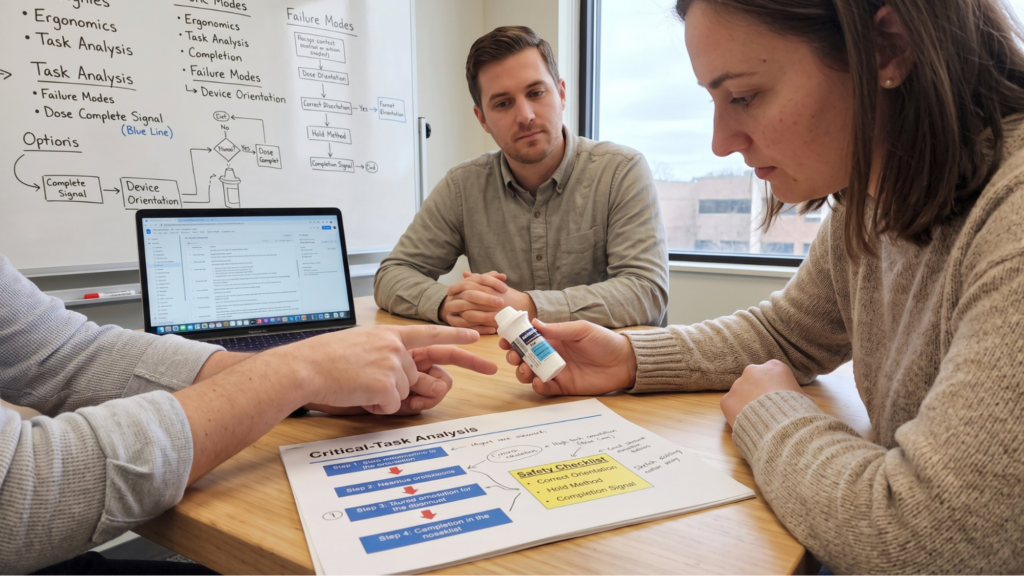
Rethinking Simplicity: From Step Count to Critical-Task Analysis
Another common assumption is that a “simple” emergency-use device is automatically easy to use correctly. Often, simplicity is measured by step count: How many actions must a person complete to administer the dose? However, this alone cannot enure that users are able to identify, understand, and perform those actions, however few.
Human Factors studies pose a more vital question: Which actions must the user absolutely get right? A critical task analysis helps answer this. Rather than focusing on the number of steps, it helps identify the key actions (use-based or comprehension-based) that are essential to successful use of the product and examines how the user interface supports them. This can reveal if the necessary cues and instructions have been considered and implemented, to make critical actions clear to a user. Examples of possible challenges that can arise during use include:
- Can the user determine how to hold the device?
- Can they identify the correct orientation?
- Can they understand where to administer the medication?
- Can they tell whether the dose administration is complete?
This shift in focus directly benefits both users and product development teams:
- Impact on Users: Clear visual, physical cues, distinctive orientation features, and concise instructions and labeling can help users orient the device, perform critical tasks, and recognize when the dose has been delivered. In a life-threatening emergency, when stress can make it harder to think clearly or recall training, these design elements can make the product easier to use correctly without relying on memory or lengthy instructions.
- Impact on Development: Teams can systematically evaluate potential failure modes and their possible consequences, allowing them to refine and improve the device, packaging, labeling, and use instructions early in development.
Ultimately, the goal is not merely to design the fewest possible steps, but to make critical actions clear and address known and anticipated use-related risks effectively. For instance, the Nasdepi® product comprises a “simple” single-use device: the user places the device nozzle in a patient’s nostril, regardless of the patient’s head position, and fully depresses the device plunger without needing the patient to inhale at the same time. When dose administration is complete (ie, when the plunger is fully depressed), a blue line on the plunger base disappears, providing a clear visual cue that the dose has been delivered. The plunger remains inaccessible to be depressed again, providing a design-driven cue that the device cannot be reused. These signals can help avoid use errors such as incomplete dose administration or attempting to re-use an empty device.
This process highlights why intuitive products are rarely intuitive by accident. They are developed by challenging assumed obviousness of tasks or instructions and by observing how representative users interact with a user interface, and where use errors occur.

Testing Emergency Epinephrine for the Real World
Most devices are designed at a desk and tested in a lab, but emergency treatment is given at home or school, on a noisy sports field, in a dim restaurant or on a crowded bus, by someone frightened for the person in front of them. Factors such as noise, poor lighting, distractions, and panic can all affect how someone handles an emergency treatment.
Belhaven’s Human Factors evaluations analyze realistic use scenarios across different user groups, including those without prior training. Testing also simulates environmental factors like noise and lighting to closely replicate the conditions in which an emergency product may need to be administered.
This leads to a shift in focus from asking, “Can someone use this product after we’ve demonstrated how?” to asking, “Can someone understand what to do when there’s no one around to explain it?”. For users with prior experience with similar products, it is also essential to consider another important question: “Will their prior knowledge assist them, or could it lead to incorrect assumptions?”.
The ultimate goal is to understand the product usability, not only when everything goes as planned, but also while accounting for unpredictable conditions and human behaviors. Testing has to find those failures points before a real emergency does.
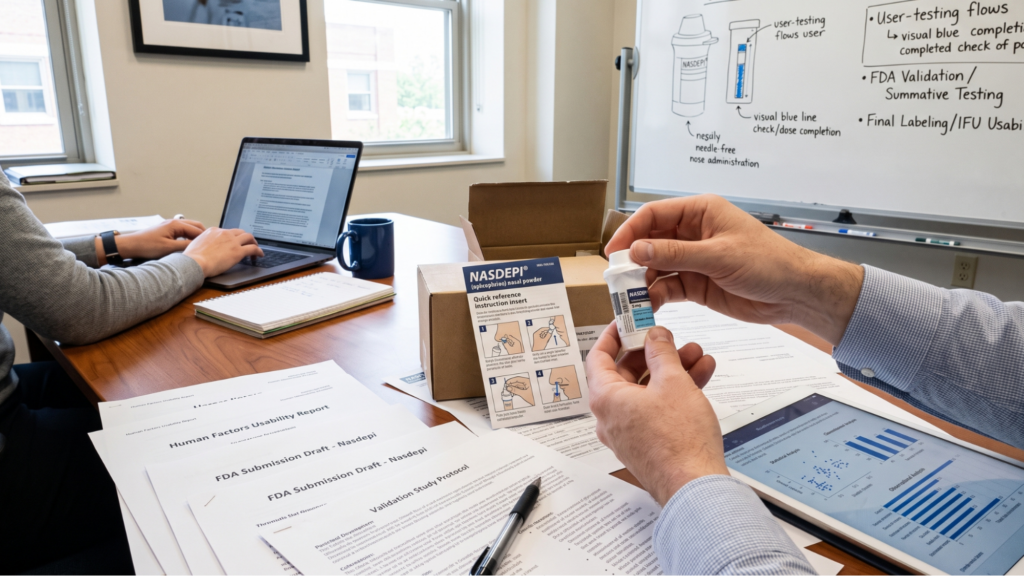
What the Right Form Factor Means for Nasdepi®
So, what is the right form factor for emergency epinephrine?
The answer depends as much on user interface, device size, shape, and delivery mechanism, as it does on human behavior and the circumstances of use. A compact two-step device that users hold the wrong way round fails. So does a needle-free device that leaves a user unsure about whether a dose was delivered. The right form factor is one where the people most likely to be holding the device can use it correctly for the first time, under the worst foreseeable conditions.
An emergency-use product has to work for someone who is encountering it for the first time, as well as those who have been trained previously or have experience with other similar products. Each of these users can encounter a distinct user error, and design and testing must anticipate and address them all. Human Factors testing measures exactly this by observing if target user groups can handle and use the device correctly in realistic conditions, and where they fail when they can’t.
Belhaven has completed formative Human Factors usability evaluation of Nasdepi® and is now preparing for the validation stage, having incorporated FDA’s feedback on labeling and instructions for use. The validation/summative study will evaluate the final user interface to ensure that identified use-related risks have been reduced as far as reasonably possible, supporting Belhaven’s New Drug Application submission to the FDA.
Nasdepi® is an investigational product and has not been approved by the U.S. Food and Drug Administration.
